“One and the Same Person” Statutory Declaration
Quick answer
InstantDeedPoll.co.uk is an independent document service and is not affiliated with HM Government.
- Personalised statutory declaration PDF with the exact 1835 Act wording and blank jurat
- Automatic exhibit cover pages for the documents you reference
- Witnessing instruction card with the £5 + £2 statutory fee rules
- Unlimited free re-downloads for 12 months
- 60-day wording acceptance guarantee — see the refund policy for scope
Free preview before you pay · No account needed · Refund policy
See a document exampleAcceptance guarantee: if HM Passport Office, the DVLA, HMRC or any UK bank refuses to accept your document solely because of its wording, tell us within 60 days and we will refund you in full.
Updated
WARNING: In England and Wales, knowingly and wilfully making a statutory declaration false in a material particular is an offence under section 5 of the Perjury Act 1911, punishable by up to two years’ imprisonment or a fine, or both. Other jurisdictions have their own laws. Do not sign this document until you are in front of your witness.
See what you receive
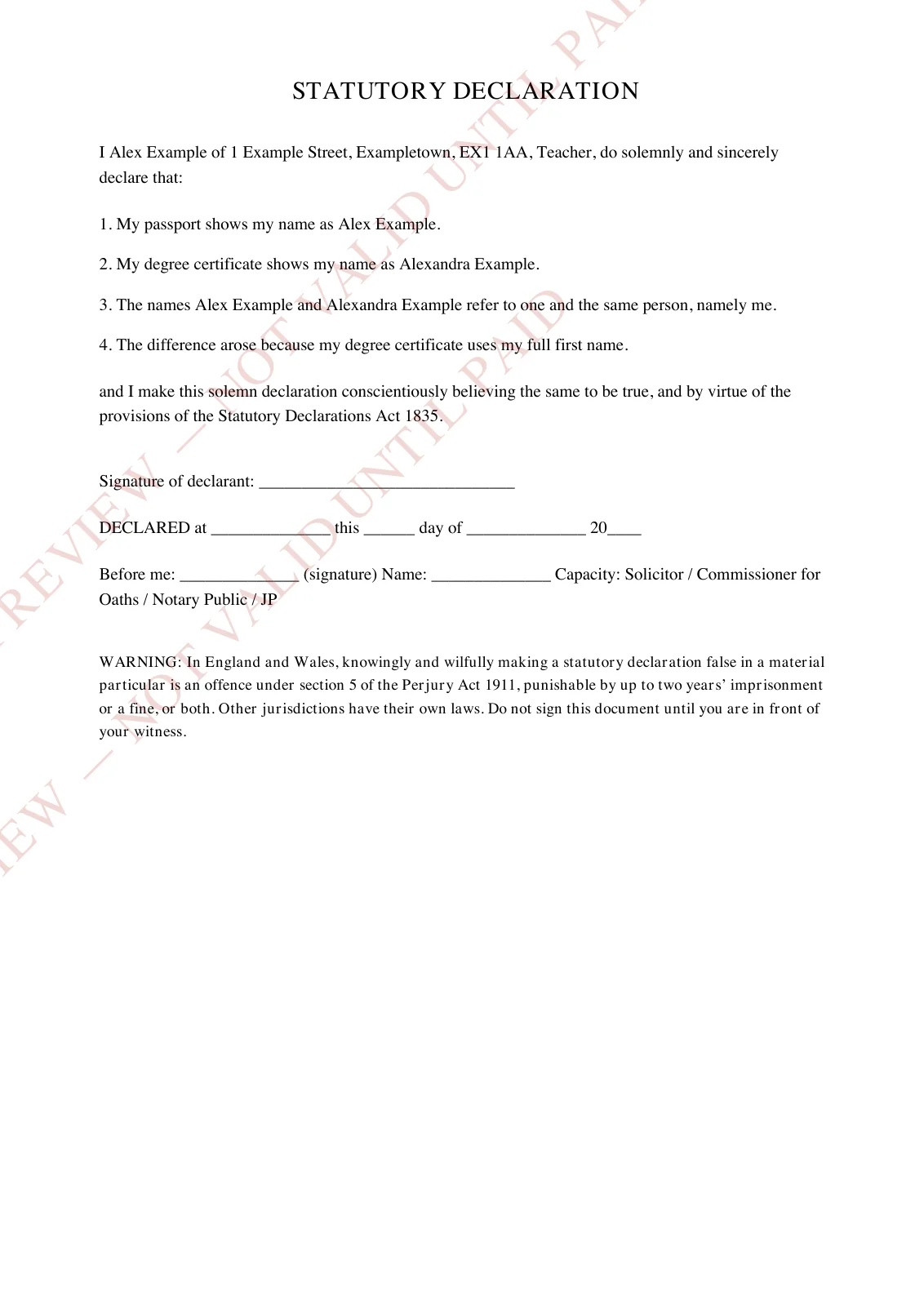
A look inside your document
 Open example image (opens in a new tab)
The example identifies two documents carrying different names and explains why they refer to the same person, followed by the declaration and signature spaces.
The preview watermark is removed from your paid PDF. Your details and the length of your answers may change the layout.
You can also check a personalised preview before paying. Follow the instructions supplied with your final documents.
Open full-size example image (opens in a new tab)How it works
Fill in, in 3 minutes
Answer a few plain-English questions about your declaration. No legal knowledge needed — and you can preview your document free before you pay.
Check your declaration
Your declaration uses the prescribed opening and closing wording of the Statutory Declarations Act 1835. Check that your statement is accurate and that the receiving organisation accepts this form before paying.
Instant PDF by email
Pay once — £9.99. Your personalised PDFs arrive by email within minutes, with instructions and free re-downloads for 12 months.
Sign in front of an authorised witness
Do not pre-sign. Sign in front of a solicitor, Commissioner for Oaths, notary or JP, who watches you sign then signs, dates and stamps it. Ask for the fee for your jurisdiction and service; see our witness cost guide.
Guarantee and support
60-day wording guarantee
Acceptance guarantee: if HM Passport Office, the DVLA, HMRC or any UK bank refuses to accept your document solely because of its wording, tell us within 60 days and we will refund you in full.
Read the refund policyOne-time payment
Yours forever. No subscription, no hidden fees, and unlimited free re-downloads for 12 months.
See delivery and purchase termsClear document preparation
Our templates draw on GOV.UK deed poll wording and the Statutory Declarations Act 1835. Your PDF is prepared automatically, with instructions for signing. Individual legal review is not included.
How our documents are preparedInstantDeedPoll.co.uk is an independent document service and is not affiliated with HM Government.
Read our acceptance guarantee
Acceptance guarantee: if HM Passport Office, the DVLA, HMRC or any UK bank refuses to accept your document solely because of its wording, tell us within 60 days and we will refund you in full.
One-time payment. Yours forever. No subscription, ever.
Why do name discrepancies cause problems?
Banks, universities, pension providers and passport counters match names exactly; a middle name missing here or a married surname there can stall an application for weeks. A statutory declaration resolves it formally: you state the name on each document, declare they are one and the same person, and explain the difference — a witnessing solicitor then confirms your identity.
When is a “one and the same person” declaration the right fix?
When your records are correct but show your name in different forms, and the organisation asking wants a formal statement linking them. If a record is simply wrong, correcting it is usually the better fix; if you want a new name, you need a change of name document instead.
| Your situation | Usually the first step | When a declaration helps |
|---|---|---|
| A middle name, initial or shortened first name is missing from one record | Ask that organisation to update its record to match your passport or birth certificate | When it asks for formal proof that both versions are you |
| Some records show your birth surname and others your married surname | Your marriage or civil partnership certificate, which shows both names | When you cannot produce the certificate, or the names do not appear on it exactly |
| You changed your name, possibly several times, and cannot show every link | HM Passport Office asks for a statutory declaration covering every name you have used | This is the declaration: list each name, when you used it and why it changed |
| Your birth was registered with a spelling mistake | Apply to correct the register (England and Wales: £83 or £99) | While the correction is pending, if the recipient accepts one |
| You live abroad and local officials question your name history | An HM Passport Office data subject rights request showing the names on your passports | If the authority asks for an affirmation or affidavit, made before a local notary |
Sources: HM Passport Office names evidence guidance, GOV.UK: correct a birth registration and FCDO: documents for British people abroad, all checked 24 September 2026.
What should the declaration say?
It should name each document, give the name exactly as shown on it, state that every version refers to you, and explain how the difference arose. Keep to facts you know, in date order.
- Opening: your current full name, address and occupation, followed by the prescribed 1835 Act words.
- One paragraph per document: what it is, who issued it, its date or reference number, and the name printed on it.
- The link: a statement that each of those names refers to you, one and the same person.
- The reason: for example, a middle name omitted when a certificate was issued, or a surname used after marriage.
- A name history, where needed: HM Passport Office asks for every name used, when each was used and, if known, the circumstances of each change.
- Exhibits: a reference to each copy attached, marked A, B and so on.
Sign in the name you use now. HM Passport Office’s guidance says staff must not accept a change of name declaration without the 1835 Act legal statement or one signed only in the old name. Knowingly making a false statement in a statutory declaration is a criminal offence.
Will HM Passport Office accept it?
HM Passport Office accepts statutory declarations as evidence of a change of name, provided the declaration includes the 1835 Act legal statement, is signed in the new name and is witnessed by an authorised person. It also asks for evidence that you use the name.
Unless an exception applies, its caseworker guidance needs 2 separate pieces of evidence for a passport in a new name: one showing that you have changed your name, and one showing that you use the new name for all official purposes, including the part of the name that changed. Where you cannot show every link between names with documents from the time, it asks for a statutory declaration covering all the names you have used. Read the passport name-change guide before you apply, and see who HM Passport Office accepts as a witness.
What does it cost to have it witnessed?
In England and Wales, a Commissioner for Oaths charges £5 for the declaration plus £2 for each exhibit that must be marked, inclusive of VAT where payable. A declaration with two exhibits therefore costs £9 to witness, on top of our £9.99 PDF.
That fee is set by the Commissioners for Oaths (Fees) Order 1993. In Scotland, sign before a notary public or a Justice of the Peace; the Scottish Courts and Tribunals Service says JP signing is currently free, by appointment. In Northern Ireland, nidirect’s guidance on parking penalty declarations lists a solicitor, Commissioner for Oaths, Justice of the Peace, notary public, or a resident or lay magistrate. Drafting advice, certified copies, notarial work and apostilles are priced separately.
How is this different from a deed poll?
A deed poll changes your name going forward; a “one and the same” declaration explains an existing discrepancy without changing anything. If you actually want to adopt a new name, use a deed poll for £14.99 or a name-change statutory declaration instead.
How do I sign it?
Never pre-sign. Book a witnessing appointment, bring photo ID, proof of address and the documents you are exhibiting, sign in front of the witness, and they complete the jurat. Read who can witness a statutory declaration for the full rules.
Ask the organisation first whether it wants the original declaration or a copy, and whether the exhibits must be certified copies. If the declaration will be used abroad, ask whether it also needs an apostille, and arrange that after the witnessing.
| Route | Price or quote | What you get |
|---|---|---|
| Required official form | Usually free to obtain | Use the prescribed form where the receiving organisation requires one; witnessing is separate |
| InstantDeedPoll.co.uk Personalised PDF | From £9.99 once | Personalised PDF and instructions. Single status £14.99. Authorised witnessing is separate |
| Commissioner for Oaths | £5 + £2 per exhibit | England and Wales schedule: £5 per declarant and £2 per required exhibit, inclusive of VAT where payable |
| Drafting, advice or notary | Individual quote | Confirm the jurisdiction, professional service, VAT and any legalisation costs |
Good to know